My work requires facts and logic. I just can’t wrap my head around the concept of the universe. What is it? Where did it come from? How was it created? What existed before the big boom theory and why/how did it exist. We are tens of million years until we lose the small toe we no longer need, so I realize we are likely primitive compared to other beings in the universe. So my reaction is to believe there might be something much bigger, whatever that might be, that cannot be explained by ANY being in the universe. Using logic to explain the possibility something illogical exists is a different take, but that’s how I look at it.
@ProblemTalk let me ask you the question then.
From all the gods, all various religions believe in, why would your god be the one ? Why would any of the other religions be wrong ?
1 Like
How much detail would you like me to give?
It is a bit more complicated than that, but yes. Muslims would also say the same about Allah, that he would not accept non-Muslims.
Why do you believe that those of all faiths will be welcome, what evidence do you have for that?
God accepts those he choses to accept ultimately, and he has decided to accept all those who have faith in him.
If I may ask, what is your opinion on morality? Do you think the universe is functioning properly?
The Bible teaching predestination, however your asserting that actions on earth having no bearing is not accurate to Christian theology.
Our actions and thoughts do very much affect our salvation and we have the free will to do whatever we like within our own ability; however, God being all-knowing, knew the decisions ever free creature he could possibly create, would make, and thus could chose who would be saved based on who he made and in which possible universe.
There is evidence in quantum mechanics for the exists of an immaterial consciousness that could be seen as the soul.
What metaphysical commitments were they?
I don’t ask for details. I ask how you can Ryhme all those gods together and claim yours is the only one that’s right ?
And then in the answer to @Colt1911 you ask him for evidence. No one has ever been able to provide proof of the existence of god. So as long as you can simply use claims to get your point across, so can anyone else.
1 Like
I have no evidence for my beliefs just as no one has evidence to prove the existence, or non-existence, of God. It’s the “it’s a bit more complicated than that” that’s confounding to me. What you seem to be suggesting is that God creates everything and everyone BUT has just one religion that will be accepted into their kingdom. So God creates humans and plays a cynical little game of rewarding only those who choose the right religion. Sorry, I don’t buy it.
What is my opinion on morality? Well that’s a loaded question, isn’t it? I’ll start with #5 through 10 of the Ten Commandments they make sense but I personally have an issue with #4 because my alcoholic father violated #6 and 10 when he cheated on my mother who had cancer and fathered two children with another woman. Should he still be “honored” in your religion because he deposited sperm in my mother?
I haven’t found a way yet to answer your question “is the universe functioning correctly” because I haven’t found a way to evaluate the vastness of the entire universe we know to exist. My personal universe is functioning quite well, thank you. The universe for a child captive to sex trafficking and repeatedly raped by men probably isn’t too good, is it?
Let me flip this back to you…
What is your opinion on morality?
How do you think the universe is functioning, and how are you able to know how it’s functioning trillions of light years from planet earth?
1 Like
Omniscient, omnipotent, omnibenevolent God, the trinity, transubstantiation, immaterial souls (the hard problem of consciousness is really hard!), Heaven, etc.
With regards to your discussions with others about morality, I find the Euthyphro Dilemma pretty hard to get around, and it suggests to me that the concept of morality independent of God is a pretty reasonable and defendable position.
Totally agree. It’s a “you know it when you see it” approach. Common sense should be a guide, but common sense has become much less common.
Euthyphro is a good dilemma to bring up here, as would be the ever popular theodicy. If god is omnipotent, omniscient and omnibenevolent, how can there be evil in the world? Most Christians I have encountered so far act as if the problem can be easily resolved and ignore that theology has struggled with the problem for centuries.
Most will come up with something along the lines of “Evil arises from free will granted to us by God” etc … but ignore that this contradicts the dogma of omniscience. If god doesn’t know how any particular human will act, he’s not omniscient. If he does know, free will is an illusion. If he doesn’t care that free will leads to evil, he’s not all-loving. If he can’t design a universe without evil in it (as in: The best possible worlds theory) he’s simply not omnipotent.
The same goes, of course, for god making humans choose the right religion if they want salvation. That’d hardly be omnibenevolent. Can’t lead us all to salvation? No omnipotence. Doesn’t know what’s going in some parts of the world? Whoops, no omniscience.
2 Likes
To answer your second paragraph first, evidence, proof and claims are all different things, do not conflate them like that.
The reason why I asked how much detail you would like is because philosophers and theologians had dedicated their entire lives to this subject alone, with there being scores of books on the subject; I shall do my best to condense their arguments.
I shall approach your question:
how you can Ryhme all those gods together and claim yours is the only one that’s right ?
From two different angles, by looking at the universe first, and then by looking at each religion.
The Universe:
- We know mathematically and we think scientifically that the universe had a beginning, meaning time, space and matter all began to exist at one time.
- Nothing cannot have created them, so it must have been something, and that something must have not been comprised of any of them, and must be more powerful than all of them
- The universe also functions in ways that can be expressed mathematically, maths is infinite, so whatever created that, must also be infinite as finality cannot produce infinity.
- We know from quantum physics that conscious observation can affect reality, and that observation itself is not material nor energetic, so whatever created consciousness must be powerful enough to do that as well, so we can infer that it itself is either conscious or beyond.
- So, from all of this we can infer that the creator of what is must be: immaterial, non-energetic, timeless, infinite, conscious or more, powerful and intelligent.
- Now for morality. All humans have a sense of right and wrong in one way or another. If morality exists it cannot come from science, as science tells us what is, not what should be. You cannot get an ought from an is. So either morality is not real, or whatever produced it is beyond nature. This rules of deism.
- Dualism is not possible, as that would require a standard beyond the equal good and evil powers for one to meet and the other to shirk; meaning whatever created that standard would be the greatest power.
- So far we have worked out that the greater of the universe must be an immaterial, non-energetic, timeless, infinite, conscious or more, powerful, intelligent, moral thing. (Moral meaning, the source or standard of morality)
- Now then, what would such a being want from us? We are but a particle on a spec floating a grain in the corner of an insignificant galaxy floating in the middle of nowhere in an endless expanse of everything. This being is so powerful he could never require anything of us. There is nothing we could ever do to move the creator, not alter nor influence in anyway. The creator would not need us for anything, so we can discount all philosophies and religions that say that actions or habits can do anything for or earn anything from the creator.
- This means that the creator would have had to create us purely for self-satisfaction or pleasure, as we can provided literally nothing beyond just existing.
- So from all that, we can look for the religion which best matches that, which is Christianity.
To demonstrate that, we shall go through all the other religions, although first I do need to clarify something. It is a common misconception that Christians believe in only one god, which is not true, we worship one God, the God. The Bible refers to several other lesser spiritual beings (and some material ones) as gods in one way or another. In fact the original word used in the Bible: elohim could mean a lot more than just The God. It does not exactly translate very well.
This all means that if Allah, or Vishnu or Baal or Zeus or any of the others exist, that does not conflict with Christian theology; they would just be considered fallen elohim. (As in, ones not inline with The God)
-
So, we are looking for the absolute creator of the universe. We can immediately discount religions that do not have theism, such as Buddhism.
-
We can also discount all of the gods that live in the universe in one way or another. (So pantheistic gods) So this would be the pagan gods, the indigenous American gods, and the Hindu gods. This does not mean to say that these gods do not exist, they might very well do, but they are not all powerful enough to have created the universe and meet the other conditions we worked out before, they cannot be the creator, so there must be a yet greater being.
-
This leaves the Abraham religions. (If you can think of any others, please let me know)
-
The Quranic/Islamic dilemma discounts Islam as the Quran affirms the inspiration, preservation and authority of the Bible and Tanakh (Hebrew Bible). They however reject further scriptures, especially those that contradict them in many places such as the Quran and Hadiths. This means that if the Bible is true, Islam is false, and if the Bible is not true, Islam is also false. Again, this does not mean Allah is not real in some sense, it just discredits his book.
-
This leaves Judaism and Christianity, both of which agree on the same pre-messiah, post-messiah structure, they just disagree on if Jesus was legitimate. Regardless they both affirm the Father as God, and you can judge for yourself if Jesus was based on the historical evidence of the New Testament.
So very briefly, that is my case. I am sorry it is such a ramble, I hope it made sense.
Evidence and proof are not the same thing, you can know that something can never be proved, but still make a judgement based on the preponderance of evidence. There certainly is evidence that God exists, even if it is very poor.
I am not surprised you do not buy it as that is a terrible strawman of what Christians believe.
It was not intended to be, I genuinely just wanted to know your perspective.
Wow that is awful, I am so sorry to hear that, that must have been so hard.
You should honour him as the person who gave you life, but you certainly should not honour someone who immoral action. Someone else’s poor behaviour is not an excuse for us to behave poorly. Justice is there to deal with immoral action, and I hope your father will face it.
Yes, this was my mistake, I worded it poorly. I was intending to ask what you think of natural evil, so volcanos, earthquakes, things like that that we deem as bad, but without a moral agent. How do those fit into your view of morality with regard to your ideas of God?
I take a standard virtue ethics view on morality which seems to be taught by Christ. Something is good is produces virtue and something is bad if it detracts from it.
Well in terms of morality, I do not think it is functioning properly as bad things can happen, and if the source of morality is God or at the very least beyond the universe, then the universe is not functioning as intended by God.
As for physical functioning, I suppose you could argue entropy is an example of the universe not functioning properly.
It all makes a lot of sence and, in some way, isn’t even new to me. But this leaves us with the always unanswered question which stops all of this:
Who created the creator ? Believers simply say the creator has always been there. For us non believers this isn’t satisfactory.
The inconsistent triad is not really a good object as it avoids motive and theological background.
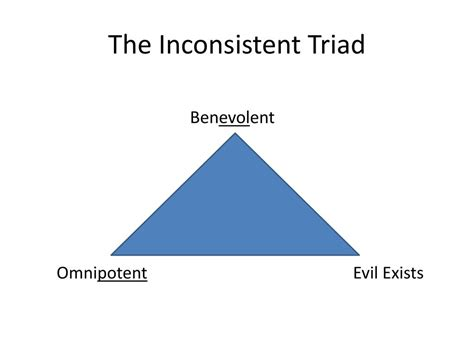
Now I will say that the last time I read up on this subject, one of the main atheist philosophers who writes on morality and the problem of evil ( I have forgotten his name) said he was working on a new book or thesis to reply to the latest Christian arguments, so this field is evolving at the moment from argument to argument, so what I say here might be out of date soon.
The problem with the triad is that it assumes that there cannot be a loving reason for evil to be permitted to exist.
Let us look at an example to demonstrate what I mean.
Imagine a baby that has just been born and his parents are taking him to have his injections so he is vaccinated. These injections hurt and the baby cries, this is literally the worst pain he has ever experienced, if he had the ability to do so, he might concluded that either, his parents did not love him, or that they were unaware of his pain. When in reality, they are aware of both, and the baby is unaware of the benefit of the vaccines and the pain is an unavoidable consequence.
The same might be true of evil and God. The inconsistent triad can only be used if you can prove, and there could never be an ultimately beneficial reason to permit evil to exist for a time.
So using your virtue example as representing morality, having sex with a partner that is not intended to procreate could be considered immoral? What virtue exists between two people that have sex simply because they desire the intense pleasure surrounding the act?
You could make the same argument relative to dancing, enjoying music, or having an occasional adult beverage. Since these things do not produce virtue, they should be shunned?
Oh good, I am glad it made sense! Haha.
Who created the creator ? Believers simply say the creator has always been there. For us non believers this isn’t satisfactory.
This is a question that is very popularly despite it being not used at all by philosophers. If you would like an atheist thinker who has talked on the subject, I would suggest Michael Ruse, who said the question itself was not taking seriously what Christians believed. But as I am sure you will say that is just an argument from authority (which it is, fair point, haha) so I shall explain why it does not work for a few reasons.
Firstly mathematically, even if God did not exist, you would still have the problem of first cause. You cannot count backwards forever and not get to 1 and then 0. You can count up forever, but not down and still stay in positive numbers.
So if we count backwards in time or logical steps, there has to eventually be a first step/cause, that is defined not by its own cause, but by the necessity for it to exist. So there has to be an uncaused first cause or an uncreated creator, as otherwise it would go back for infinity, which means that in order to get to where we are now, we would have past infinity, which is impossible.
The next reason is time. Time had a beginning and as I argued above, whatever created would therefore have to be beyond it. If the creator exists outside of time, then there could not have been a time before he was created, or a time he was created. He would exist once and forever externally outside of time.
Thirdly, Christians of course believe that God is the ultimate source of everything, so if you want to argue that he would need a creator, you would then need to argue that either logically the Christian God would be one, or an ultimate source could not exist.
Does any of that make sense?
To let you know, I am not a Catholic, I do not believe all intimate activity has to have the possibility of producing a child, I am in this forum after all, haha.
Joy is a virtue. Enjoyment is a virtue, as long as it is not outweighed by a detraction from virtue, (so enjoying beating someone up for example) then everything that produces them is fine.
Shunning is not permitted in Christianity, it itself being sin a detracting from virtue. The most the Bible says you can do is not allow people who openly and willingly rebel against Christian moral teachings claiming it to be good, from attending Church.
I actually know a few people who were banned from taking holy communion because they had children out of wedlock. Sure sounds like shunning to me.
Shunning and baring from participation are not the same thing.
They would have been disallowed because of 1 Corinthians 11:27-29
“Whoever, therefore, eats the bread or drinks the cup of the Lord in an unworthy manner will be guilty concerning the body and blood of the Lord. Let a person examine himself, then, and so eat of the bread and drink of the cup. For anyone who eats and drinks without discerning the body eats and drinks judgment on himself.”
We believe that there are grave spiritual consequences when handling communion incorrectly, which is why it is so restrictive.
Baptism on the other hand, is open to everyone, or at least it is in my denomination. It cannot be refused unless you yourself refuse to participate.